
Ban the killer robots before it's too late
April 3, 2013 -- Updated 1509 GMT (2309 HKT)
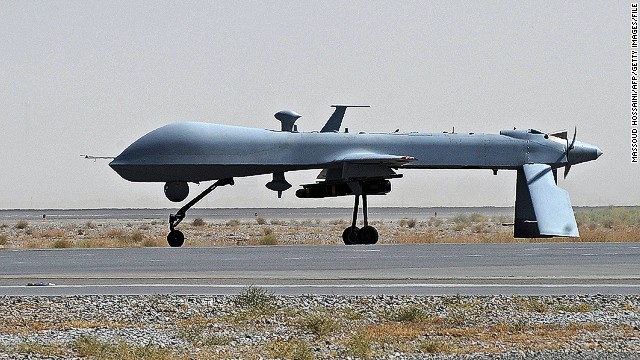
A U.S. Predator unmanned drone armed with a missile on the tarmac at Kandahar military airport in June 2010.
STORY HIGHLIGHTS
- UK robotics professor leading calls for a worldwide ban on autonomous weapons
- We can't rely on robots to conform to international law, says Noel Sharkey
- Sharkey is chairman of and NGO leading a campaign to "Stop Killer Robots"
- Autonomous robots could destabilize world security and trigger unintentional wars
Editor's note: Noel Sharkey is Professor of Artificial Intelligence and Robotics and Professor of Public Engagement at the UK's University of Sheffield and Chairman of the International Committee for Robot Arms Control.
(CNN) -- As wars become increasingly automated, we must ask ourselves how far we want to delegate responsibility to machines. Where do we want to draw the line?
Weapons systems have been evolving for millennia and there have always been attempts to resist them. But does that mean that we should just sit back and accept our fate and hand over the ultimate responsibility for killing to machines?
Over the last few months there has been an increasing debate about the use of fully autonomous robot weapons: armed robots that once launched can select their own targets and kill them without further human intervention.
"We just shouldn't grant machines the decision about who lives or dies
Noel Sharkey, Chairman of ICRAC
Noel Sharkey, Chairman of ICRAC

Professor Noel Sharkey
Some have argued that robots could be more accurate on the battlefield than human soldiers and save more civilian lives. But this is speculation based on assumptions about future developments of computer hardware and software. It is no more than "hopeware" -- since the 1950s, Artificial Intelligence has moved at a snail's pace compared to what proponents have predicted.
Others argue that even if robots could be more accurate under some restricted circumstances at some unknown time in the future, we just shouldn't grant machines the decision about who lives or dies.
At this point, we cannot rely on machines having the independent facility to conform to international law. Current sensing systems are not up to the task. And even if machines had adequate sensing mechanisms they would still be missing the vital components of battlefield awareness and common sense reasoning to make decisions about who and when it is appropriate to kill.
Robots do not have the agency to decide if striking a target is proportional to the expected military advantage. There is no metric for this. Much of war is art and not science. A military commander must make a qualitative decision about the number of civilian lives that can be risked for a particular military objective. And that commander can be held accountable.
A robot doesn't have the moral agency to be held accountable. Some would argue that the commander who sends a robot on a mission would be responsible (last point of contact). But that could be unfair since it could be the fault of the mission programmer, the manufacturer or one of dozens of little companies providing components. Maybe it should be the senior staff or policy makers who had the idea to use robots. Or the device could have been tampered with in the industrial supply chain or even damaged in action. Forensics are extremely difficult with such complex devices.
"Is anyone considering how autonomous weapons could destabilize world security and trigger unintentional wars?
Noel Sharkey, Chairman of ICRAC
Noel Sharkey, Chairman of ICRAC
Yet a recent U.S. DoD directive (November 2012) gives a green light to research and development of autonomous weapons systems while presenting a cautious route to their deployment.
This is borne from a culmination of U.S. military road maps dating back to 2002 and it is a bad move. It sends the wrong message to other nations. As the most militarily advanced nation on the planet, the U.S. has the opportunity to take the take the lead in halting these developments.
Thanks to the U.S.'s use of drones, more than 70 other countries have acquired the technology in a new arms race. It is simply blinkered to think that they will not follow suit with autonomous weapons. Is anyone thinking about how an adaptive enemy will exploit the weaknesses of robot weapons with spoofing, hacking or misdirection?
Is anyone considering how unknown computer programs will interact when swarms of robots meet? Is anyone considering how autonomous weapons could destabilize world security and trigger unintentional wars?
In April this year in London, a group of prominent NGOs will launch a large civil society campaign to "Stop Killer Robots." They are seeking a new legally binding preemptive international treaty to prohibit the development and deployment of fully autonomous robot weapons.
The aim is to stop these weapons getting into the arsenals of the world's militaries while there is still an opportunity. Once there has been large national investments in the technology, it may be too late.
Do you think autonomous robot weapons should be outlawed? Leave your comments below.
The opinions expressed in this commentary are solely those of Noel Sharkey.
We recommend
From around the web

April 30, 2013 -- Updated 1421 GMT (2221 HKT)

Thinner than a human hair but 300 times stronger than steel? No wonder scientists are getting so excited about the "miracle material."
April 19, 2013 -- Updated 1744 GMT (0144 HKT)

Stomping through the fields and industrial wastelands of Britain, this giant six-legged walking robot is a world first, say its creators.
April 10, 2013 -- Updated 0921 GMT (1721 HKT)

"Sometimes Buddha, Jesus or Mohammed appear, but usually they don't ..." says Dr. Steven Laurays, head of the Belgian-based Coma Science Group.
April 3, 2013 -- Updated 1509 GMT (2309 HKT)

As wars become more automated, we must ask how far we want to delegate responsibility to machines, says Noel Sharkey.
March 27, 2013 -- Updated 1442 GMT (2242 HKT)

U.S. physicists have created a way of making objects "invisible." It's not Harry Potter's invisibility cloak just yet, but scientists say it has potential.
March 12, 2013 -- Updated 1340 GMT (2140 HKT)

We need to innovate alternative energy sources now more than ever, says Steven Cowley. Fusion energy could be the answer, he thinks.
March 6, 2013 -- Updated 1315 GMT (2115 HKT)

Raffaello D'Andrea isn't short of admirers for his autonomous flying robots and the amazing tricks they perform; from juggling to playing the piano.
October 12, 2012 -- Updated 1402 GMT (2202 HKT)

It sounds like a sci-fi nightmare, but scientists working on the Human Brain Project hope to improve understanding of diseases of the mind.
October 4, 2012 -- Updated 1035 GMT (1835 HKT)

Astrobiologist Charles Cockell says searching for signs of alien life on Earth and in space will help us solve our environmental challenges.
October 2, 2012 -- Updated 1854 GMT (0254 HKT)

Humans have reached the moon, sent rovers to Mars, but the land deep beneath our feet remains largely uncharted. That may be about to change.
March 28, 2012 -- Updated 1033 GMT (1833 HKT)

The world's biggest radio telescope could offer insights into the formation of the universe and might even detect alien life.
March 13, 2012 -- Updated 1102 GMT (1902 HKT)

The U.S. Naval Research Laboratory (NRL) is developing a humanoid robot to tackle naval blazes.
April 9, 2012 -- Updated 1547 GMT (2347 HKT)

New technology is letting scientists map the brain's connections in ever-greater detail.
March 2, 2012 -- Updated 1326 GMT (2126 HKT)

The tiny $35 Raspberry Pi has gone on sale. Designers hope the mini-PC will inspire children to learn about computer programming.
September 24, 2011 -- Updated 1908 GMT (0308 HKT)

Prototype system of wheel-mounted LED lights make a bike far more visible from the front, back and the side, say creators.


74°
HI 79°LO 60°
Atlanta, GAWeather forecast
Home | Video | World | U.S. | Africa | Asia | Europe | Latin America | Middle East | Business | World Sport | Entertainment | Tech | Travel | iReport
Tools & Widgets | RSS | Podcasts | Blogs | CNN Mobile | My Profile | E-mail Alerts | CNN Radio | CNN Shop | Site map | CNN Partner Hotels
 © 2013 Cable News Network. Turner Broadcasting System, Inc. All Rights Reserved.
 |
| 
No comments:
Post a Comment