


Blogs

Where paleontology meets pop culture
| 
Meet the members of the tangled human family tree
| 
How human ingenuity is changing the way we live
| 
Ideas, news and discoveries from the world of science
|

April 30, 2013
Look Ma, No Fuel! Flying Cross Country on Sun Power


The Solar Impulse flying over San Francisco at night. Photo courtesy of Jean Revillard/Solar Impulse
Bet you didn’t know that Texas has more solar energy workers than ranchers and California has more of them than actors, and that more people now work in the solar industry in the U.S. than in coal mines.
Or that in March, for the first time ever, 100 percent of the energy added to the U.S. power grid was solar.
Okay, so now you know all that, but I’m guessing you’re no more aquiver over solar energy than you were five minutes ago. That’s the way it is in America these days. Most people think solar is a good thing, but how jazzed can you get about putting panels on a roof.
Bertrand Piccard understands this. Which is why later this week, weather permitting, he will take off from Moffett Field near San Francisco and begin a flight across the U.S. in a plane entirely dependent on the sun. Called Solar Impulse, it will move at a snail’s pace compared to commercial jets–top speed will be under 50 miles per hour–and will stop in several cities before it ends its journey in New York in late June or early July.
But the point isn’t to to mimic a plane in a hurry, crossing the country on thousands of gallons of jet fuel. The point is to show what’s possible without it.
Batteries included
To do this, Piccard and his partner, André Borschberg, have created one of the strangest flying machines ever–a plane with the wingspan of a jumbo jet, but one that weighs about a ton less than an SUV. Its power is generated by nearly 12,000 silicon solar cells over the main wing and the horizontal stabilizer that charge lithium-polymer battery packs contained in the four gondolas under the wing. The batteries in total weigh almost 900 pounds–that’s about one quarter of the plane’s weight–and they’re capable of storing enough energy to allow the plane to fly at night.
Piloting the Solar Impulse is neither comfortable nor without a good deal of risk. Only one pilot can be in the cockpit–a second adds too much weight–and the engines are vulnerable to wind, rain, fog and heavy clouds. But Piccard is, by blood, an inveterate risk-taker. In 1999, he co-piloted the first gas-powered balloon to travel non-stop around the world. In 1960, his father, Jacques, was one of the two men aboard the bathysphere lowered into the Marianas Trench, the deepest part of the world’s oceans. In 1931, his grandfather, Auguste, was the first balloonist to enter the Earth’s stratosphere.
It was near the end of his own record-setting balloon trip that Bertrand Piccard was inspired to find a way to fly without needing to rely on fuel. He almost ran out of propane while crossing the Atlantic. He and Borschberg spent years planning, designing and finding investors–that was no small challenge–but they persevered and, in 2010, the Solar Impulse made the first solar-powered night flight over Switzerland. Last year it completed the first solar intercontinental flight, from Europe to Africa.
The ultimate goal–after the flight across America–is to fly a solar plane non-stop around the world. That’s tentatively scheduled for 2015, but it will require a bigger plane than the Impulse. Since they estimate that it will take three days to fly over the Atlantic and five to cross the Pacific, Piccard and Borschberg have been making other alterations, too–the larger version will have an autopilot, more efficient electric motors and a body made of even lighter carbon fiber. It also will have a seat that reclines and yes, a toilet.
There certainly are easier ways to go around the world, but Piccard sees his mission as stretching our imaginations about the sun’s potential. “Very often, when we speak of protection of the environment, it’s boring,” he said during a recent interview with Popular Science. “It’s about less mobility, less comfort, less growth.”
Instead, he wants to show that clean energy can just as easily be about being a pioneer.
Here comes the sun
Here’s other recent developments related to solar power:
- It’s always good to save some for later: A team of researchers at Stanford University has devised a partially liquid battery that could lead to the development of inexpensive batteries which can store energy created by solar panels and wind turbines. One of the challenges of both sun and wind power is to be able to store energy efficiently so it’s available when the sun’s not shining and the wind’s not blowing.
- Forget the undercoating, we’ll throw in solar panels: BMW, which will begin selling its first electric cars later this year, says it will offer buyers the opportunity to get a solar-powered home charging system designed to be installed in their garages.
- Go ahead and fold. Avoid spindling and mutilation: A Milwaukee middle school teacher-turned-inventor has created a small, foldable solar array that can charge an iPhone in two hours.Joshua Zimmerman turned what had been a hobby into a company named Brown Dog Gadgets and he’s already raised more than $150,000 on Kickstarter to get his business off the ground.
- And you thought your shirt was cool: An Indian scientist has designed a shirt containingsolar cells that power small fans to keep the wearer cool. The shirt would also be able to store enough juice to charge cell phones and tablets.
- Charge of the light brigade: Since you never know when you need a lantern, there’s now a solar powered bottle cap that lights up your water bottle. Its four bright, white LED lights can turn your beat up water bottle into a shiny beacon.
Video bonus: Take a peek at the Solar Impulse during its test flight over San Francisco last week.
More from Smithsonian.com
April 26, 2013
How Big Data Will Mean the End to Job Interviews

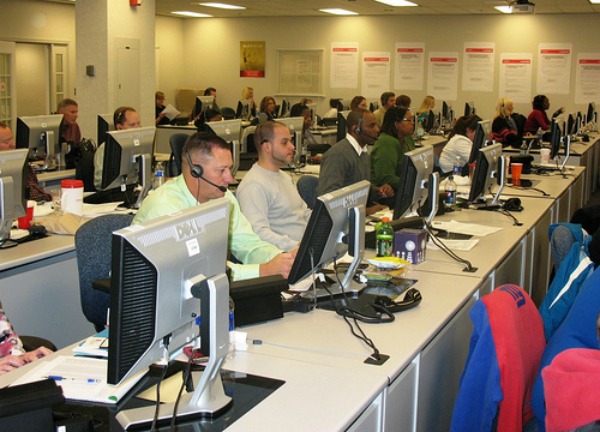
Who makes a good call center worker? Big Data knows. Photo courtesy of Flickr user State Farm
I have good news and bad news for anyone who will be looking for a job in the coming years. The good news is that some time in the future, job interviews may go away. Okay, maybe some companies will still do them for the sake of tradition, but they won’t matter all that much.
Which leads me to the bad news–Big Data is more likely to determine if you get a job. Your dazzling smile, charming personality and awesome resume may count for something, but it’s algorithms and predictive analysis that will probably seal your fate.
Here’s why. Enormously powerful computers are beginning to make sense of the massive amounts of data the world now produces, and that allows almost any kind of behavior to be quantified and correlated with other data. Statistics might show, for instance, that people who live 15 miles from work are more likely to quit their jobs within five years. Or that employees with musical skills are particularly well-suited for jobs requiring them to be multilingual. I’m making those up, but they’re not so far-fetched.
Some human resources departments have already started using companies that mine deep reserves of information to shape their hiring decisions. And they’re discovering that when computers mix and match data, conventional wisdom about what kind of person is good in a job doesn’t always hold true.
Run the numbers
Consider the findings of Evolv, a San Francisco company that’s making a name for itself through its data-driven insights. It contends, for instance, that people who fill out online job applications using a browser that they installed themselves on their PCs, such as Chrome or Firefox, perform their jobs better and change jobs less often. You might speculate that this is because the kind of person who downloads a browser other than the one that came with his or her computer, is more proactive, more resourceful.
But Evolv doesn’t speculate. It simply points out that this is what data from more than 30,000 employees strongly suggests. There’s nothing anecdotal about it; it’s based on info gleaned from ten of thousands of workers. And that’s what gives it weight.
“The heart of science is measurement,” Erik Brynjolfsson, of the Sloan School of Management at M.I.T., pointed out in a recent New York Times article on what’s become known as work-force science. “We’re seeing a revolution in measurement, and it will revolutionize organizational economics and personnel economics.”
Evolv, which largely has focused its research on hourly employees, has spun from data other strands of of H.R. gold, such as:
- People who have been unemployed for a long time are, once they’re hired again, just as capable and stay on their jobs just as long as people who haven’t been out of work.
- A criminal record has long been a thick black mark for someone in the job market, but Evolv says their statistics show that a criminal background has no bearing on how an employee performs or how long they stick with a job. In fact, it has found that ex-criminals actually make better employees in call centers.
- Based on employee surveys, call center workers who are creative stay around. Those who are inquisitive don’t.
- The most reliable call center employees live near the job, have reliable transportation and use one or more social networks, but not more than four.
- Honesty matters. Data shows that people who prove to be honest on personality tests tend to stay on the job 20 to 30 percent longer than those who don’t.
And how do they gauge honesty? One technique is to ask people if they know simple keyboard shortcuts, such as control-V, which allows you to paste text. Later they’ll be asked to cut and paste text using only the keyboard to see if they were telling the truth.
It’s getting creepy
Data-driven hiring has its flaws, of course. One is that it could result in unintended discrimination against minority or older employees. Minority workers, for example, tend to travel farther to their jobs. And that could create legal problems for a company that steers clear of long-distance employees because statistics show they don’t stay in jobs as long.
Then there’s the matter of what lengths a company will go to gather data on its workers. Where will it draw the line when it comes to tracking employees’ behavior in the name of accumulating data?
“The data-gathering technology, to be sure, raises questions about the limits of worker surveillance,” Marc Rotenberg, executive director of the Electronic Privacy Information Center, told The New York Times. “The larger problem here is that all these workplace metrics are being collected when you as a worker are essentially behind a one-way mirror.”
That’s a serious issue, but it’s not likely to slow the trend of replacing a boss’ gut reaction with the perceived wisdom of algorithms.
Case in point: Earlier this year eHarmony, the company that’s made its mark in online matchmaking, announced plans to tweak its algorithms and get into the business of hooking up employees and companies.
Big Data is watching
Here are other ways Big Data is having an impact:
- The roads less traveled: Delivery companies like Fedex and UPS are starting to see significant savings by using data analysis to guide drivers to less congested roads to avoid idling in traffic.
- Have phone, will travel: Scientists in Africa are using data gathered from cell phone usage totrack the spread of diseases like malaria by seeing where people travel.
- Big C, meet Big D: The American Society of Clinical Oncology has launched a project to create a massive database of electronic records of cancer cases so doctors can apply analytics to determine how to best treat patients.
Video bonus: Still don’t get the whole Big Data thing. Photographer Rick Smolan shares his epiphany about it.
More from Smithsonian.com
April 24, 2013
Eight New Things We’ve Learned About Music


Music works deep into our brains. Photo courtesy of Flickr user antonkawasaki
In one those strange twists of modern life, we were reminded last week of the power of music–at a hockey game.
It was at Boston’s TD Garden, two days after the explosions that contorted so many lives, and as singer Rene Rancourt began the Star Spangled Banner before the game between the hometown Bruins and the Buffalo Sabres, he noticed that many in the crowd were joining in. Rancourt got only as far as …”what so proudly we hailed” before he pulled the microphone away from his mouth and motioned to those in the stands to carry on. They did, in full voice, building to a stirring finish.
Yes, it would have been a powerful moment had those 17,000 people stood and cheered in unison. But they sang together, without restraint, and that moved us in a way we can’t fully comprehend.
Welcome to the pleasure center
Why is it that music can affect us in such profound ways? “Because it does” seems like a pretty good answer to me, but scientists aren’t that easy. They’ve been wrestling with this for a long time, yet it was not that long ago that two researchers at McGill University in Montreal, Anne Blood and Robert Zatorre, came up with an explanation, at least a physiological one.
Based on MRI scans, they found that when people listened to music they liked, the limbic and paralimbic regions of the brain became more active. They’re the areas linked to euphoric reward responses, the same ones that bring the dopamine rush associated with food, sex and drugs. (Right, so throw in rock and roll.)
Okay, but why? Why should a collection of sounds cause the brain to reward itself? That remains a bit of a mystery, but a favorite theory, proposed almost 60 years ago, posits that it’s about fulfilled expectations. Put simply, music sets up patterns that causes us to predict what will come next and when we’re right, we get a reward. Some have suggested this has its roots in primitive times when guessing wrong about animal sounds was a matter of life or death. What was needed was a quick emotional response to save our skin, rather than taking a time to think things through.
And so, the theory goes, our response to sound became a gut reaction.
And the beat goes on
The truth is we’re learning new things about music all the time. Here are eight studies published in just the past few months.
1) But can you dance to it?: Toronto researcher Valorie Salimpoor wanted to know if our strong emotional response to a song we like is due to the music itself or some personal attachment we have to it. So she had a group of people listen to 30-second samples of songs they’d never heard before, then asked them how much they’d be willing to pay for each track. And she did MRI scans of their brains while they listened. The result? When the nucleus accumbens region became active–it’s a part of the brain associated with pleasant surprises or what neuroscientists call “positive prediction errors”–they were more willing to spend money. In other words, if a song turned out better than they had expected, based on pattern recognition, they wanted more of it.
2) Drum solos not included: Two McGill University psychologists in Montreal say that soothing music can actually be more effective than Valium when it comes to relaxing people before surgery.
3) Unless their favorite song is by Metallica: And it helps even the tiniest of babies. A study at Beth Israel Medical Center in New York found that when parents turned their favorite songs into lullabies and sang or played them on an instrument, it reduced stress levels in the infants and stabilized their vital signs.
4) The ultimate mind meld: Back to brain scans. Stanford neuroscientist Daniel Abrams determined that when different people listened to the same piece of music–in this case a little known symphony–theirbrains reflected similar patterns of activity. And those similarities were observed not just in areas of the brain linked with sound processing, but also in regions responsible for attention, memory and movement.
5) You know you love “Gangnam Style”…Ooops, sorry about that: Yes, scientists are even doingresearch on earworms or as most of us know them, songs that get stuck in our heads. And the latest study found that contrary to conventional wisdom, it’s usually not awful songs that we can’t seem to get rid of. Most often, it’s songs we actually like, even if we don’t want to admit it. Researcher Ira Hyman also has suggestions for how to get rid of an earworm–you need to engage in a task that requires the auditory and verbal components of your working memory–say, reading a good book.
6) No language barrier here: Previous research has shown that people with a musical background are more likely to be able to learn a second language, and now a new study suggests that people who speak a language that’s tonal, such as Cantonese, may be better suited to learning music. Understanding Cantonese requires a person to master six different tones, each of which can change the meaning of words. On musical tests taken by non-musicians as part of the study, those who spoke Cantonese scored 20 percent higher than English-speaking participants who didn’t play music.
7) Some day you’ll thank me for this, kid: A study published in the Journal of Neuroscience suggests that musical training before the age of seven can have a major effect on brain development. Those who learned how to play chords at an early age tend to have stronger connections between the motor regions of their brains.
8) Say what?: So loud music may not ruin your hearing after all. At least that’s the conclusion of New South Wales scientist Gary Houseley, who says his research showed that loud music causes hearing to diminish for only about 12 hours. His study was able to demonstrate that when sound levels rise, the inner ear releases a hormone which reduces the amount of sound transmitted by the ear hair’s cells. That reduces our hearing sensitivity for a while, but it also keeps our ears from being permanently damaged.
Video bonus: Then there are the people who can improvise music. Researcher Charles Limb took a look inside their brains.
More from Smithsonian.com
A Few Rare People Hallucinate Musical Scores
When You Work Out to Music, Your Whole Body Syncs Up to Its Music
When You Work Out to Music, Your Whole Body Syncs Up to Its Music
April 19, 2013
Do Teachers Need Their Own “Bar Exam”?


Do teachers need to train more like doctors? Photo courtesy of Flickr user WoodleyWonderworks
Question: What’s needed to raise the quality of school teachers in America?
Answer: A bar exam?
So say the head of the country’s most powerful teachers’ union, the governor of New York and the U.S. secretary of education, among others. Their contention is that the only way teachers can truly elevate their profession–and with it the level of public education–is if they follow the lead of doctors, lawyers and engineers and are required to pass a test to prove mastery of their subject matter and how to teach it.
Randi Weingarten, president of the American Federation of Teachers (AFT), first floated the idea last summer at the Aspen Ideas Festival when asked what more could be done in training teachers. Then, late last year, her union put out a report, titled “Raising the Bar,” that pushed the idea further, calling for “a rigorous entry bar for beginning teachers.”
The debate has raged on ever since.
Smarten up
Joining those singing the praises of a tough teacher assessment is Joel Klein, the former chancellor of New York City’s Department of Education. Writing on The Atlantic website, he pointed out that pretty much anyone who graduates from college in America today can become a teacher, and that “job security, not teacher excellence, defines the workforce culture.” He also quoted a sobering statistic from McKinsey: The U.S. gets nearly half of its teachers from the bottom third of its college classes.
And just last weekend, in the New York Times, Jal Mehta,an associate professor at the Harvard Graduate School of Education, wrote that compared to many other fields where quality is maintained by building a body of knowledge and training people in that knowledge, “American education is a failed profession.”
He added:
“We let doctors operate, pilots fly and engineeers build because their fields have developed effective ways of certifying that they can do these things. Teaching, on the whole, lacks this specialized knowledge base; teachers teach based mostly on what they have picked up from experience and from their colleagues.”
So what exactly do the proponents have in mind? For starters, they think any exam would need to focus both on the prospective teacher’s subject and on teaching more generally, particularly the social and emotional aspects of learning. While states would be able to adapt the guidelines, the intent would be to set national certification standards. And, above all, the process would need to be “rigorous.” They say “rigorous” a lot.
AFT’s proposal also recommends that American universities need to get much more selective in accepting students into education programs, that they should require a minimum of a 3.0 grade point average, plus an average score in the top third percentile on college entrance exams. The goal, ultimately, is make teaching a skill to be mastered, and one that requires serious preparation. Said Weingarten: “It’s time to do away with a common rite of passage into the teaching profession—whereby newly minted teachers are tossed the keys to their classrooms, expected to figure things out, and left to see if they and their students sink or swim.”
Class action
Of course, not everyone thinks this is such a good idea. Some critics have suggested that it’s a ploy by the teacher’s union to sound high-minded, while actually aiming to protect its current members–who likely wouldn’t have to take the exam–and to justify a sizable bump in salary. Or that it’s really a swipe at programs like Teach for America, which offers a different route to becoming a teacher.
Still others think that focusing so much on a test score doesn’t make sense for a profession so dependent on interpersonal and motivational skills. Jonathan Kozol, author of numerous books on education, including “Letters to a Young Teacher,” makes the point that no test, no matter how refined, could adequately measure what he thinks is a good teacher’s greatest quality, that he or she loves being with students. The only way you can gauge that, he says, is watching them teach.
And Jason Richwine and Lindsey Burke, both of the conservative think tank, the Heritage Foundation,argued recently in The Atlantic that having knowledge and being able to impart it are two different things. They wrote:
“A teacher with a doctorate degree, every certification and license available, and 15 years of experience is no more likely to be a high performer than a teacher with a B.A., the minimal certification, and five years of experience.”
Finnish products
In the end, this discussion often ends up in Finland. It’s the Magic Kingdom of Education, the place the experts talk about when they imagine what American teachers could be. Roughly 40 years ago, the Finnish government concluded that the key to the country’s economic future was a first-class public education system. And the key to that was a system that gave teachers the prestige of doctors.
To even be accepted into a Finnish teacher education program, candidates must be at the top of their class, complete exams on pedagogy, be observed often in clinical settings, and pass a challenging interview. Only about 1 in 10 Finnish applicants are accepted to study to be teachers. And while the U.S. has more than 1,200 universities that train teachers, Finland has only eight. In short, teachers need to earn the right to feel special.
So, does that elevated status of teachers there result in better students? Yes, you could say that. In science, in math, in reading, Finnish students rank first in the world.
Teaching moments
Here are other recent innovations in education:
- Never start by trying to learn Chinese: One of the hot trends in higher education is predictive analysis, which evaluates data to help identify students at risk of dropping out and also which course sequences are more likely keep kids in school and which are more likely to make them choose to drop out.
- Even tests can be all about you: A new online portal called Smart Sparrow allows teachers to offer material that’s adapted specifically to a student. For instance, quiz questions can be based on how a student answered the previous question. If he got it right, the next question’s harder, if he got it wrong, it’s easier.
- Do the math: A company called Mango Learning is building a reputation for its mobile apps that teach grade school kids math. They’re interactive games that supposedly can make kids even want to add decimals.
Video bonus: The Young Turks online news show offers its take on what makes Finnish education so special.
More from Smithsonian.com
April 15, 2013
Should We Fall Out of Love with Robot Surgery?
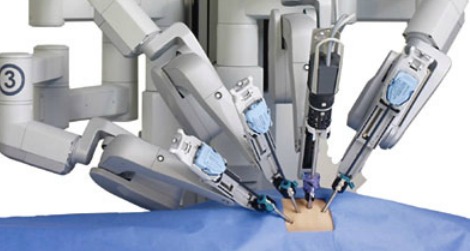

A da Vinci robot zeroes in. Photo courtesy of Intuitive Surgical
Last fall, shoppers outside a Macy’s store in Boston were given a chance to test drive a robot. They were invited, compliments of Brigham and Women’s Hospital, to sit at a console and move the machine’s arm the same way surgeons would in an operating room.
And why not? What says cutting-edge medicine more than robotic surgery? Who wouldn’t be impressed with a hospital where robot arms, with all their precision, replace surgeons’ hands?
The surgeons, of course, control the robots on computers where everything is magnified in 3D, but the actual cutting is done by machines. And that means smaller incisions, fewer complications and faster recoveries.
Usually.
But earlier this year, the Food and Drug Administration (FDA) began surveying doctors who use the operating room robots known as the da Vinci Surgical System. The investigation was sparked by a jump in incidents involving da Vinci robots, up to 500 in 2012.
The California company that makes the da Vinci, Intuitive Surgical, says the spike has to do with a change in how incidents are reported, as opposed to problems with its robots. It’s also true that robot surgery is being done a lot more frequently–almost 370,000 procedures were done in the U.S. last year, which is three and a half times as many as in 2008.
And the procedures are getting more complicated. At first, the robots were used primarily for prostate surgeries, then for hysterectomies. Now they’re removing gall bladders, repairing heart valves, shrinking stomachs during weight loss surgery, even handling organ transplants.
Unkind cuts
Not surprisingly, FDA survey has stirred up a swirl of questions about machine medicine. Have hospitals, in their need to justify the expense of a $1.5 million robot, ratcheted up their use unnecessarily? Has Intuitive Surgical placed enough emphasis on doctors getting supervised training on the machines? And how much training is enough?
It’s not an uncommon scenario for technological innovation. A new product gets marketed aggressively to companies–in this case hospitals–and they respond enthusiastically, at least in part because they don’t want to miss out on the next big thing.
But is newer always better? A study published recently in The Journal of the American Medical Association,compared outcomes in 264,758 women who had either laparoscopic or robotically assisted hysterectomies at 441 different hospitals between 2007 and 2010. Neither method is invasive.
But the researchers found no overall difference in complication rates between the two methods, and no difference in the rates of blood transfusion. The only big difference between the two is the cost–the robotic surgery costs one-third more than laparoscopic surgery.
Then there’s the matter of loosening training standards. When the FDA allowed the da Vinci system to be sold back in 2000, it was under a process called “premarket notification.” By claiming that new devices are similar to others already on the market, manufacturers can be exempted from rigorous trials and tough requirements. In this case, Intuitive Surgical was not formally required to offer training programs for surgeons.
The company did tell the FDA that it planned to require a 70-item exam and a three-day training session for doctors. But, as a recent New York Times article noted, Intuitive changed its policy just two years later. Instead it required surgeons to pass a 10-question online quiz and spend only a day in hands-on training.
So ultimately it’s up to the hospitals to set training standards. But in their rush to embrace the future, they can be tempted to avoid being too demanding. In one 2008 case that has resulted in a lawsuit against Intuitive, a patient suffered serious complications, including impotence and incontinence, while having his prostate gland removed. The surgeon, it turned out, had never done robotic surgery without supervision before.
A researcher at Johns Hopkins Hospital, Dr. Martin Makary, who has previously criticized hospitals for overhyping robotic surgery on their websites, has another study coming out soon that suggests that the problems involving da Vinci robots are underreported. “The rapid adoption of robotic surgery,” he contends, “has been done, by and large, without the proper evaluation.”
Dr. David Samadi, Chief of Robotics and Minimally Invasive Surgery at the Mount Sinai School of Medicine in New York, has a different way of looking at robotic surgery: “A good driver in a Lamborghini is going to win NASCAR. But someone’s who not a a good driver in a Lamborghini…he’s going to flip the car and maybe kill himself.”
Robots rising
Here are some other ways robots are being used in hospitals:
- Down go the mean old germs: Doctors at Johns Hopkins Hospital in Baltimore have turned to robots to take on the superbugs that have become such a threat of spreading dangerous infections among patients. After a hospital room is sealed, the robots spend the next half hour spraying a mist of hydrogen peroxide over every surface. Other hospitals are taking a a different approach in dealing with nasty bacteria–they’re using robots that zap germs with beams of ultraviolet light.
- And you’ll be able to see your face in the scalpel: GE is developing a robot that will keep the tools of the operating room sterile and organized. Instead of relying on humans doing this by hand–clearly not the most efficient process–the robot, by recognizing unique coding on each piece of equipment, will be able to sort scalpels from clamps from scissors, sterilize them and then deliver everything to the operating room.
- Bedside manner, without the bedside part: Earlier this year the FDA approved a medical robot called RP-VITA, which was developed by iRobot and InTouch Health. The machine moves around the hospital to rooms of patients identified by the doctor. Once in a room, it connects the doctor to the patient or hospital staff through the robot’s video screen.
- The buddy system: Researchers at Columbia University found that the pain ratings of hospitalized children dropped significantly when they interacted with “therapeutic robot companions.”
Video bonus: When da Vinci is good, it’s very, very good. Here’s a video of a surgeon using one to peel a grape.
Video bonus bonus: Okay, admittedly this has nothing to do with robotic surgery, but it’s the hottest robot video on the Web right now–an impressive, yet somewhat creepy demo of Boston Dynamics’ “Petman” in camo gear.
More from Smithsonian.com
Advertisement
Read more: http://blogs.smithsonianmag.com/ideas/#ixzz2RzkVo5gb
Follow us: @SmithsonianMag on Twitter

No comments:
Post a Comment